Why are parts and service carrying the dealer business right now?
Who Carries the Schematic After the Manufacturer Stops?
Picture a packaging line eight years after commissioning. A drive on the infeed conveyor fails. The plant does not call the drive manufacturer. Their maintenance team may not know who made it. They call the company whose nameplate is on the machine: the integrator who designed it, sourced it and started it up.
That integrator now has three questions to answer quickly. Which part is it, exactly, in that position on that build? Is it still made? If not, what replaces it, and will it fit? The answers sit in documentation the integrator never wrote: one vendor's manual, another's PDF datasheet, a third's parts list from a catalog revision that is no longer online.
Obsolescence is now routine
PMMI Business Intelligence's 2026 Managing Obsolescence report, published in July 2026 from 190 surveys and 14 interviews across packaging and processing end users, OEMs and contract manufacturers, found that 52% of end users say obsolescence events have increased over the last five years. That is one sector, but it is the sector many integrators build for.
Component suppliers discontinue for ordinary reasons. A product line is rationalized. A company is acquired. A part is redesigned and the old number retired. None of it is aimed at integrators. Every one of those decisions still lands on a machine with an integrator's name on it.
You didn't build the parts. You still own the answer.
An OEM owns its bill of materials. A dealer works from one manufacturer's catalog. The integrator sits between them: it owns the assembly, but not most of what is inside it. When a machine holds components from fifteen suppliers, its documentation belongs to fifteen companies. The responsibility for answering the customer belongs to one.
At handover, that documentation usually looks fine. It lives in the turnover package, a project folder on the server and the head of the engineer who specified each component. Then it decays. Engineers move on. Vendor links break. Part numbers are superseded. The machine keeps running, and the record of what is inside it gets harder to find every year.
What a wrong answer costs
Identifying the right part on a multi-vendor machine is slow when the documentation is scattered, and a wrong answer is expensive. In Service Council research published in June 2023, one in five service leaders said more than 30% of their unsuccessful field visits were due to the unavailability of the appropriate part. The Service Council did not publish a sample size, and the figure covers service organizations broadly, not integrators specifically.
For an integrator, a wrong part means a second trip, freight both ways and a return. It also means a customer whose line stays down while the answer gets sorted out. The Ops or Service Lead feels it first, in technician hours, order errors and returns. The owner feels it later, when that customer remembers the downtime.
Five questions to ask about your installed base
A quick test of how exposed you are:
- For a machine you shipped five years ago, could someone other than the original project engineer identify the component in a given position?
- Is that machine's documentation in one place, or split across vendor PDFs, project folders and inboxes?
- When a vendor discontinues a component, how do you find every machine you shipped with it?
- When a replacement is confirmed to fit, where is that recorded so the next technician finds it?
- Can your customer's maintenance team identify and order a part without calling you?
Every answer that starts with "it depends who you ask" is a liability held in people, not in a system.
What consolidation looks like
Fixing this does not mean rebuilding your documentation from scratch. It asks for three things.
The first is one structure per machine that holds every vendor's components in the position they occupy, from the full machine down to each subassembly. The second is building that structure from what you already have: vendor PDFs, parts lists and photographs of the as-built assembly, since you rarely have CAD for purchased components. The third is a connection to ordering, so identifying a part ends in a quote or an order through the ERP you already run, not a phone call and a re-keyed part number.
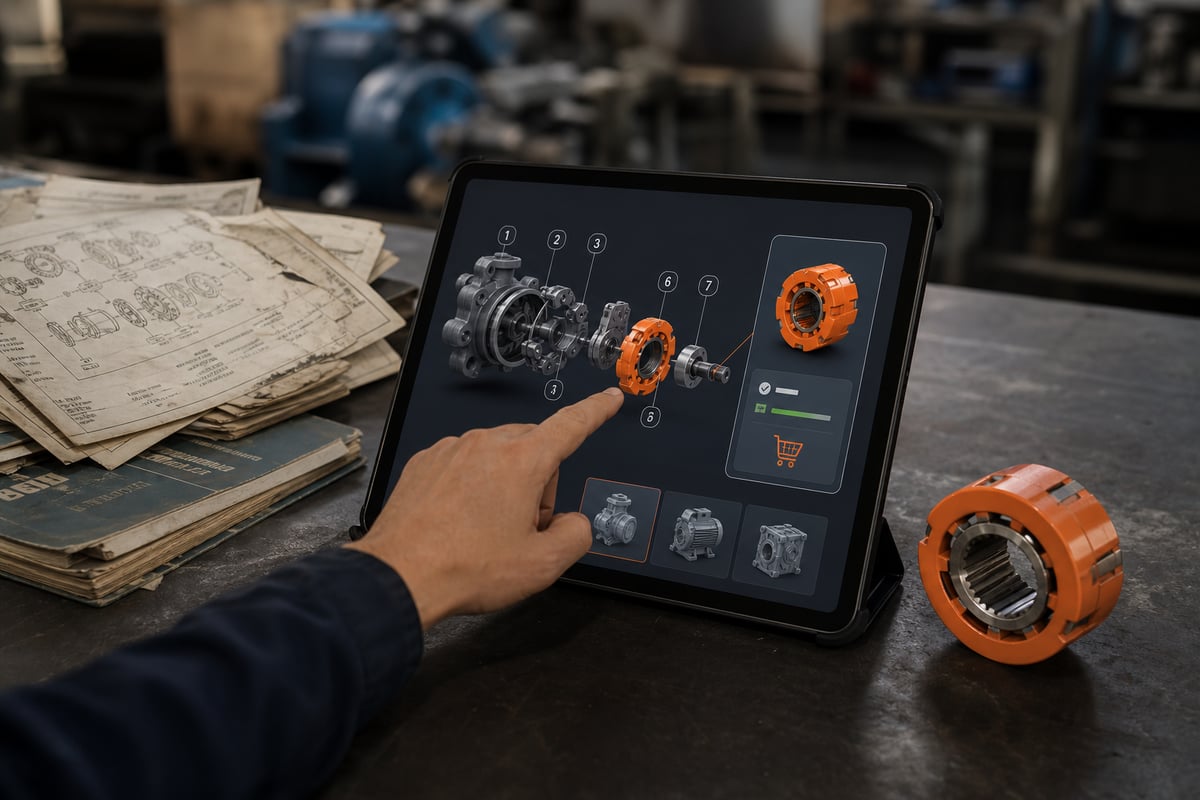
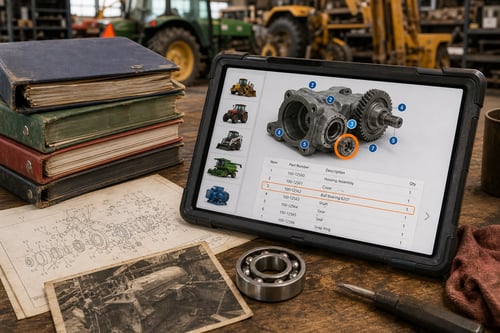
Done once per machine, the answer stops depending on who picks up the phone. A technician, a parts coordinator or the customer's own maintenance team clicks the position on the diagram and sees the part.
The call comes either way
Component suppliers will keep discontinuing parts, and customers will keep calling the integrator when they do. The question is whether the answer lives in a system your whole team can search, or with whoever specified that drive eight years ago.
Interactive Parts Schematics (IPS) turns vendor PDFs, parts lists and photographs into one clickable schematic per machine, connected to the ERP you already run. Which machine in your installed base would be hardest to support today?