How to Choose Parts Catalog Software: Six Questions
How to choose parts catalog software: test every option ...
The skilled trades shortage costs equipment dealers an estimated $7 billion a year in lost shop and parts revenue, according to the AED Foundation’s 2026 study. The parts half of that loss starts at the manufacturer. For an OEM that sells through dealers, every empty service bay and stretched parts counter is aftermarket revenue that never becomes an order.
The study, released September 10, 2026, found dealers are short about 10,000 diesel technicians a year. The Foundation’s 2016 study put the cost at about $2.4 billion, so the estimate has roughly tripled in a decade, though the two studies were run by different research teams.
Large, and dealers feel it directly. The research, produced with recruiting firm Randall Reilly, surveyed dealers, OEMs, technical schools and working technicians in one study for the first time. In the US results, 80% of dealers say they cannot meet customer demand for lack of qualified technicians, 77% say the shortage is hindering growth, and 72% report higher costs and operational inefficiency.
A Canadian edition followed on September 18, produced with the Canada Equipment Dealers Foundation. It estimates a shortfall of about 1,263 technicians a year, costing dealers CA$803 million a year in lost shop and parts sales. Seventy-eight percent of Canadian dealers cannot meet demand, 40% say they have lost customers, and a quarter have had technician jobs open for more than 150 days.
The Canadian report shows its work. Its survey base is modest (40 Canadian dealers, alongside 126 US dealers and 9 OEMs), and its dollar figures are estimates.
Almost half. The Canadian report’s arithmetic is simple. A technician bills about 1,800 hours a year at an average CA$190, or CA$342,000. For every dollar of labor billed, a dealer sells about CA$0.86 in parts, a ratio the report attributes to the service division manager of an Alberta dealer group and treats as an industry-average estimate. That adds CA$294,120, for CA$636,120 per unfilled position.
So about 46% of the loss is parts: roughly CA$370 million a year in Canada alone. A technician who isn’t there doesn’t bill hours, and that is the dealer’s loss. But a repair that doesn’t happen also doesn’t consume parts, and those parts would have been ordered from a manufacturer. The dealer books that loss. The OEM never sees the order, so it never counts it at all.
That is the uncomfortable part for a manufacturer. The cost doesn’t show up as a decline. It shows up as parts sales that stay flat against a growing installed base, with no line in any report explaining why. The repair was deferred, done by someone else with someone else’s parts, or done by the owner with whatever a search turned up [internal: Post 10].
An OEM can run the same arithmetic on its own channel: the number of dealers, the open technician positions each will admit to, and the parts a working technician pulls through in a year. The third figure is in the dealer’s own system. Few manufacturers have ever asked for it.
They are trying, but it takes years. In the Canadian edition, 72% of dealers plan to raise technician pay this year, 70% point to an education system that doesn’t prepare students for the trades, and 62% cite limited awareness of technician careers. Pay, schools and recruiting are where the shortage gets solved.
In the meantime, the technicians a dealer has are spread thinner and newer to the product. Sixty-five percent of Canadian dealers and 52% of US dealers say technician exits peak between two and five years in, just as a technician becomes fully trained and most productive. They also work across more product lines as dealer groups consolidate [internal: /dealer-network-consolidation-parts-support/], and nobody carries a dozen manufacturers’ parts books in their head.
Its parts documentation. A thirty-year technician identified parts from memory [internal: /tribal-knowledge-parts-department/]. A three-year technician identifies them from whatever the manufacturer gave the dealer. That makes the OEM’s parts documentation an input to technician productivity, and the only one the OEM fully controls.
The report points the same way. Five of the nine OEMs surveyed are developing digital tools to raise technician productivity, which the report frames as a way to reduce demand: a more efficient technician means fewer are needed for the same work. Nine OEMs is a show of hands, not a sample. It is still the manufacturers’ own answer.
No sourced figure exists for how much of a technician’s day goes to finding the right part number. The components are visible in any shop: minutes paging through a PDF for the right model year, the walk to the parts counter to ask the one person who knows, a part ordered from a superseded number [internal: Post 11], and a machine that sits in the bay two more days while the right one ships. At CA$190 an hour, with CA$0.86 in parts riding on each one, every hour lost that way has a price.
None of this fixes the shortage. It decides how much of the shortage lands on one manufacturer’s line rather than another’s. At a multi-line dealer with too few technicians, the jobs that get done first are the ones easiest to diagnose, identify and order for. Being the easy line is a decision the OEM makes in its documentation, long before the machine reaches the bay.
Parts sales per machine in the field, by dealer. Where an OEM’s parts-per-machine figure is falling and the dealer has open bays, the $7 billion has an address.
The AED Foundation’s 2026 study estimates about $7 billion a year in lost shop and parts revenue for US agriculture and construction dealers. The Canadian edition estimates CA$803 million a year and a shortfall of about 1,263 technicians.
In the Canadian edition, about CA$294,120 a year: 1,800 billable hours at CA$190, multiplied by an estimated CA$0.86 in parts per labor dollar. That is about 46% of the CA$636,120 total lost per unfilled position. The parts ratio is one dealer executive’s industry-average estimate.
A repair that doesn’t happen doesn’t consume parts, and those parts would have come from the manufacturer. The dealer books the lost sale; the OEM sees parts sales that stay flat against a growing installed base, with nothing in its reports explaining why.
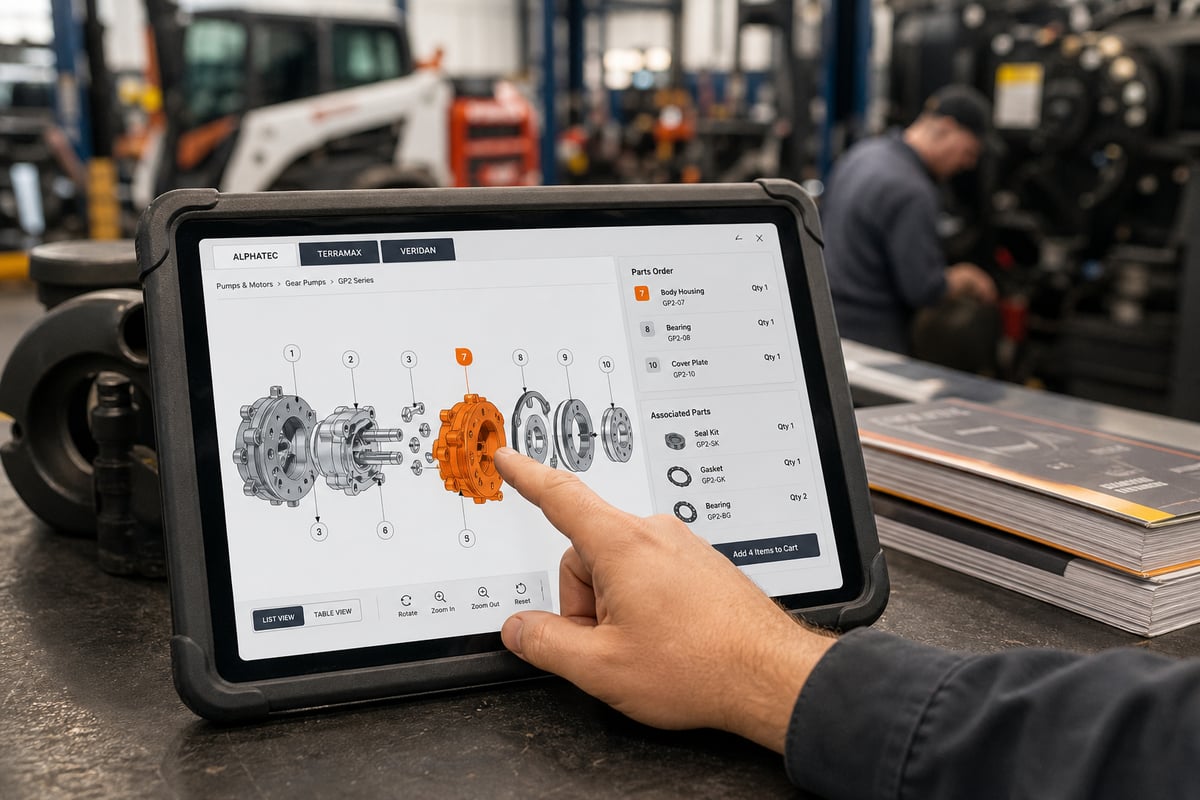
Publish parts documentation a newer technician can use without asking the one person who knows: current exploded views, the right model years and serial ranges, superseded numbers marked, and lookup that ends in an order. It won’t fix the shortage, but it decides which line gets worked first.
Interactive Parts Schematics (IPS) builds parts catalogs from photographs, PDFs and parts lists, with no CAD model required,
Which of the six would your current setup fail first?