|
The short answer
A dealer portal built on interactive parts catalog software gives your dealers self-serve access to live part numbers, tier pricing, availability, and the exploded diagram for every component. It replaces the phone call to confirm a price, the outdated PDF catalog, and the wrong-part order that follows.
|
Your dealers are building their 2027 stocking and service plans right now, in a year when parts and service are carrying more of their business than new equipment. The manufacturers whose parts are easiest to identify, price, and order will earn a bigger share of that plan. The ones still supporting dealers with emailed PDFs and a busy parts line will get worked around, usually without anyone saying so.
This article covers why that shift is happening, what it costs when dealers can’t find a part number fast, a five-step audit you can run this week to put a number on that cost, and what a dealer parts portal needs to include to fix it.
Why are parts and service carrying the dealer business right now?
Because new unit sales are under pressure and the installed base still needs parts. Farm equipment is the best-measured example. In Ag Equipment Intelligence’s 2026 Dealer Business Outlook & Trends survey of North American dealers, nearly 60% forecast parts revenue up 2% or more versus 2025, and only 7.6% expected parts revenue to decline. Over the same period, most of those dealers forecast new equipment revenue to be down or flat.
Heavy truck shows similar pressure on the new-unit side: CDK’s 2026 State of the Heavy Truck Industry study found 44% of dealers say tariffs have already reduced demand. When customers keep machines longer instead of replacing them, those machines need more parts and more service.
That demand has to be filled by someone. Dealers will source it from the manufacturers that make ordering fast and certain.
What slows dealers down when they order parts from a manufacturer?
Ask a parts manager or a service technician and you’ll hear the same short list:
- “The PDF catalog hasn’t been updated since the last model revision.”
- “The part number in the catalog doesn’t match the price list.”
- “I called the parts line to confirm the price and I’m still waiting on a callback.”
- “We ordered the wrong one because the diagram covers three serial ranges.”
- “It took three emails to get the service diagram.”
None of these is a crisis on its own. Together they create friction, and in a parts business friction shows up as lost orders. A dealer who can’t confirm a part number and price moves on to the next job. A technician who can’t find the right diagram calls a competitor’s support line. A parts manager who knows your ordering process is slow will lead with a different brand in the service conversation.
This is the passive support model: the manufacturer publishes catalogs and price sheets in bulk, then waits for the phone to ring when something doesn’t match. The dealer absorbs the reconciliation work between the catalog, the price list, and your system. For manufacturers who wonder why dealers sometimes deprioritize their brand in service work, this workflow is a large part of the answer.
How much is dealer friction costing your parts business?
Most manufacturers have never measured it, because the cost is spread across the parts desk, returns, freight, and the dealer’s own labor. You can put a working number on it in about a week using data you already have.
The five-step dealer friction audit
- Log parts-line calls for five business days by reason. Use five buckets: price confirmation, part number verification, document request, order status, and true technical support. Everything except the last bucket is a candidate for self-service.
- Cross-check your top 50 parts by volume. Compare part number, description, and price across the current dealer-facing PDF catalog, the price list, and your ERP. Every mismatch is a dealer phone call or a wrong order waiting to happen.
- Pull 12 months of wrong-part returns. Filter return reason codes for wrong part, wrong revision, or not compatible. Group by model and by dealer. Clusters usually point to one confusing diagram or one outdated catalog page.
- Measure time-to-document. Ask three dealers how long it took to get the last diagram or service document they requested. Hours or days here means technicians are waiting at the machine.
- Check catalog currency. Compare the publish date on your newest dealer-facing catalog against the date of the last engineering change on that model. Any gap means dealers are ordering from information you already know is wrong.
|
Turn the audit into a dollar figure
Parts desk time: lookup calls per week × average handle time × loaded hourly cost.
Wrong-part orders: returns per month × cost per incident (freight both ways, restocking, reorder handling, and the customer’s downtime).
Example only, use your own numbers: 40 lookup calls a day at 6 minutes each is 4 hours a day, roughly half of one full-time role spent reading part numbers aloud.
|
The audit also gives you a baseline, which matters later. If you launch a dealer portal, these same five numbers are how you’ll know whether it worked.
What should a dealer parts portal actually include?
A dealer portal isn’t a nicer place to download the same PDF. It changes the relationship around parts by giving dealers direct, authenticated access to the information your own team works from. Use this list to evaluate any interactive parts catalog software, whoever the vendor is:
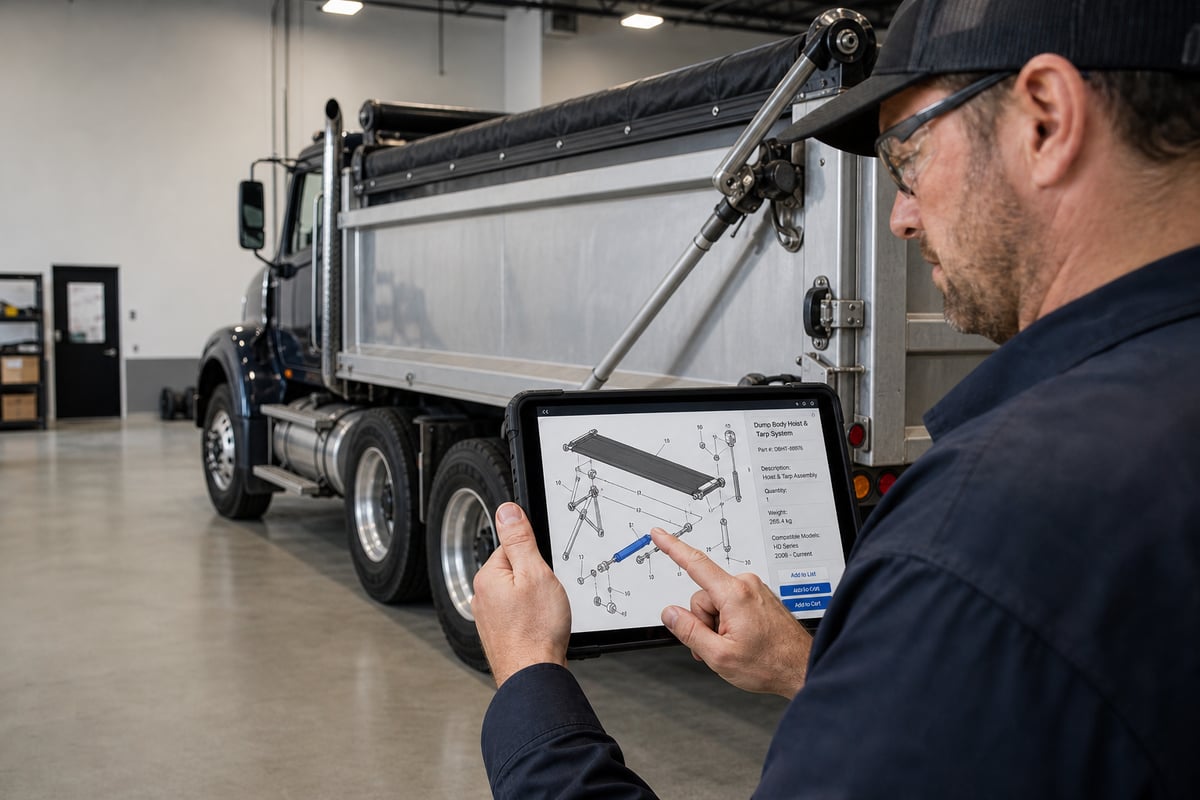
- Click-to-order diagrams. A dealer clicks a component on the exploded view and sees the part number, price, and availability, then adds it to the cart.
- Live ERP pricing by dealer tier. Pricing pulled from your ERP in real time, not a nightly spreadsheet export, so dealers see their own price without calling.
- Model, serial, and revision control. Dealers see the right parts for the unit in front of them, which is where most wrong-part orders start.
- Documentation at the component level. Service bulletins, manuals, and diagrams linked to the part, not stored in a separate folder.
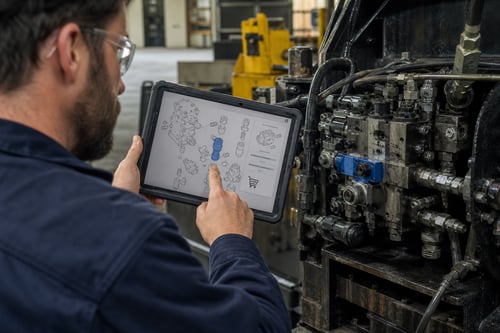
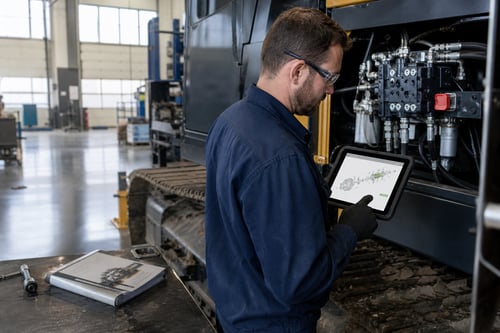
- Mobile and tablet use at the machine. Technicians identify parts on site instead of walking back to a desktop.
- Orders that flow into your existing ERP. The portal should connect to the systems you already run, not require you to replace them.
- A deployment timeline measured in weeks. The bigger variable is usually the condition of your catalog and BOM data, not the software.
How does pricing transparency change what dealers order?
Dealers make stocking and recommendation decisions partly on how confident they feel about margin. When pricing is opaque, updated irregularly, or needs a call to verify, dealers order conservatively. They stock less, recommend less, and hedge.
When current pricing is visible alongside availability, dealers can plan with confidence and make promises to their own customers: “Yes, we have it, here’s the price,” without putting anyone on hold. That capability wins service work, and more service work means more of your parts moving through the channel. It also shifts the economics on your side. Your parts team spends less time on routine lookups and more time on the complex questions that actually need their expertise.
How does an interactive parts catalog connect to the ERP you already have?
This is the use case Envalo’s Interactive Parts Schematics (IPS) was built for. It turns static PDF parts catalogs into clickable schematics connected to the ERP and commerce systems you already run, including SAP, NetSuite, and Magento, so dealers see live pricing and availability calibrated to their tier and can order directly from the diagram. Nothing gets replaced; it’s the bridge between the parts data in your back office and the dealers and technicians who need it in the field, and it can be live in weeks rather than years.
For manufacturers, that turns a passive, PDF-based support model into an active sales channel. For dealers, it means being treated like the parts customers they are.
The takeaway
Parts and service aren’t a fallback for a slow equipment year. For a growing number of dealers, they are the business. Phone calls and emailed PDFs got manufacturers this far, but dealers are now building their plans around the parts relationships that are fastest and most certain.
If your dealers built their 2027 parts plan around the manufacturer that’s easiest to order from, would that be you?
Sources
Ag Equipment Intelligence / Farm Equipment, 2026 Dealer Business Outlook & Trends (survey of North American farm equipment dealers; parts forecasts vs. 2025). CDK Heavy Truck, 2026 State of the Heavy Truck Industry study, as reported by The Trucker.