Nobody Publishes the Long Tail
A 1982 International 5288 with 6,498 hours on it sold for $30,000, AgWeb reported in April 2026, in a used market where "everyone is looking for a 10-plus-year-old tractor in good condition with low hours." The company that built it stopped making farm equipment four decades ago. International Harvester's agricultural division was sold to Tenneco, the parent of J.I. Case, in a deal completed in February 1985, and folded into Case IH.
Somebody paid $30,000 for a machine whose original manufacturer no longer exists, on the assumption that it can be kept running. That assumption rests on an obsolete parts catalog nobody is paid to maintain, and on the people who maintain it anyway.
Equipment outlives its documentation
This is not a farm curiosity. PMMI Business Intelligence's 2026 Managing Obsolescence report, published in July 2026 from 190 surveys and 14 interviews across packaging and processing end users, OEMs and contract manufacturers, found that 52% of end users say obsolescence events have increased over the last five years. The machines stay in service. The components, the support and eventually the documentation around them do not.
Manufacturers stop publishing for defensible reasons. A product line is rationalized to cut SKUs. A line is sold, and the buyer inherits a drawing archive it did not create. The company is acquired, and the parts book for a machine built three owners ago becomes nobody's job. None of this is negligence. It is the economics of a manufacturer whose attention belongs to what it sells next.
The installed base does not follow that logic. It keeps running, keeps wearing and keeps needing parts.
Who picks it up
The gap is filled by independent multi-brand service and parts specialists: shops and distributors that service equipment they did not build, across brands that compete with each other, including brands that no longer exist. They own neither the bill of materials nor the assembly. What they own is the ability to identify a part on a machine nobody else will document.
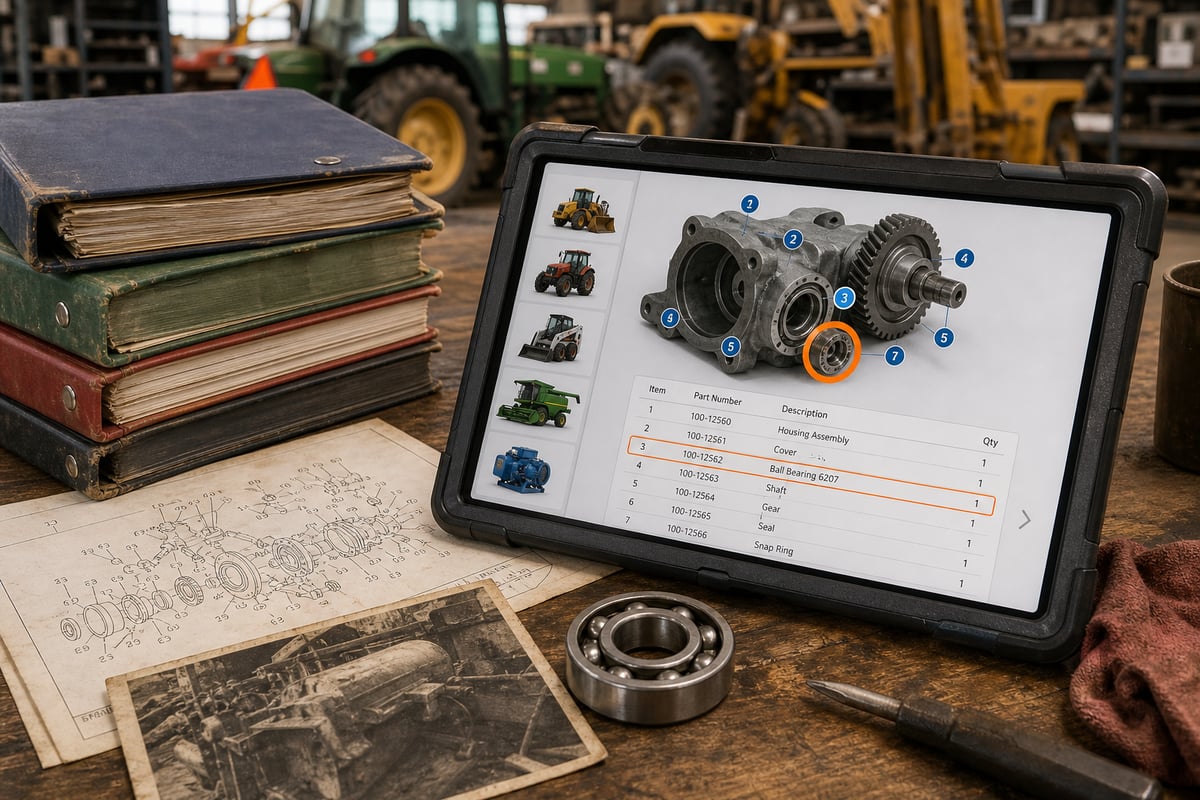
That is a different business from a dealer's. A dealer works from one manufacturer's current catalog [internal: /dealer-network-consolidation-parts-support/], backed by that manufacturer. The specialist works from a legacy equipment parts catalog it assembled itself: original parts books where they survive, photographs where they don't, and years of knowing which later part replaced which earlier one [internal: /parts-supersession-management-conversion-kit-gap/].
The hard part is the structure, not the parts
Finding a bearing or a seal for an old machine is usually solvable, because standard components carry standard numbers. The hard part is knowing that this bearing is the one in this position, on this model, in this serial range, and that the manufacturer changed it partway through the run without changing the diagram. That knowledge is the exploded view. For a discontinued line it often exists only as a photocopied parts book, a scan of one, or nothing at all.
Reconstructing it is real work. Someone photographs the assembly, identifies each component, checks it against whatever documentation survives, and records the substitutions that turned out to fit. Each wrong answer costs freight, a return and a second trip. That second trip is not rare: in Service Council research published in June 2023, one in five service leaders said more than 30% of their unsuccessful field visits were due to the unavailability of the appropriate part. The Service Council did not publish a sample size, and its respondents service current equipment as well as old.
Why it's a business, not a favor
The usual framing treats obsolescence support as a courtesy to loyal customers. The aftermarket numbers point the other way. Heading into 2026, nearly 60% of ag dealers forecast parts sales growth of 2% or more, and 62.1% forecast service revenue growth, according to the Ag Equipment Intelligence Dealer Business Outlook reported by Farm Equipment in December 2025. That is agricultural dealers only, with no published sample size, but the direction is the point: parts demand follows the machines in the field, and the machines in the field get older every year.
For the multi-brand specialist, that age is an advantage. When a shop is the only reliable source of identification for a discontinued model, its customer is paying for the right answer, not for a commodity part. And no manufacturer will ever publish its competitor's parts book, so a specialist who carries seven brands holds a record no single manufacturer can assemble.
Where does your long tail live?
The weakness is where that record lives. In most shops it is a shelf of binders, a folder of scans, a spreadsheet and one or two people who know which is which [internal: /tribal-knowledge-parts-department/]. Five questions show how durable your version is:
- If your most experienced counter person were out for a month, could someone else identify a part on your oldest supported model?
- When a substitution is confirmed to fit, where is it written down, and could anyone find it a year from now?
- How many formats does one lookup touch: binders, scans, spreadsheets, photos on someone's phone?
- Can you search every brand you carry at once, or does each brand mean a different shelf or folder?
- When a customer calls back about the same machine, does your team start from the last answer or from scratch?
If more than one or two of those answers depend on a single person, the long tail is carried by your payroll, not by your business. That knowledge leaves when they do.
What it takes to do this at scale
Carrying the long tail across brands asks for three things most parts catalog tools were not designed around [internal: /how-to-choose-parts-catalog-software/].
The first is authoring from photographs. There is no CAD model for a machine built before its manufacturer used CAD, and often no manufacturer left to ask. The second is a brand-agnostic structure that holds many manufacturers' schematics side by side, rather than assuming one publisher with one dealer network. The third is cross-brand parts lookup, so the person at the counter searches the whole record at once instead of seven parts books in seven formats.
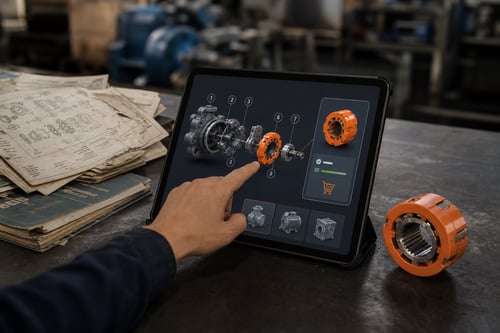
Put together, the reconstruction happens once. The assembly is photographed, the parts are tagged on the image, and every later lookup starts from a clickable diagram instead of a memory. We have built this before: a multi-brand specialist's catalog spanning seven competing manufacturers, including lines built before 2000. Aggregation works outside any manufacturer relationship, and reconstruction, once done, becomes a published record instead of a recollection.
The long tail has a price
The $30,000 tractor is a bet that someone can still tell its owner which part fits. For an independent specialist, being that someone is the business. The open question is whether the knowledge that makes it valuable sits in a structure that can be searched, shared and handed on, or in the head of the person who has been answering the phone for twenty years.
Interactive Parts Schematics (IPS) builds parts catalogs from photographs, PDFs and parts lists, and holds many manufacturers' schematics in one searchable structure. Which discontinued line in your shop would be hardest to rebuild if the binder went missing?